
Dispatch No. 27 ← Previous ↰ All Next →
TL;DR; They were too long, so I didn't read them

A TL;DR; of the TL;DRs. This story is long and complicated. Here's a breakdown of all the key points. I may seem crazy for tugging on all these threads, but I promise there is something to be learned from all of this.
Background — the one-screen version of my pro se Post Grant Review of U.S. Patent 12,460,537, which I believe copies rotation-sensing I disclosed first. This one is the whole case on a single conspiracy board; every line links to the full story if you want it. New here? Start at Dispatch No. 1.
Table of Contents
It's still too long, so you probably won't read it all the way through.
- PGR vs. Other Issues
- How to steal IP
- Mislead the examiner
- The PGR Grounds
- Other things
- Related dispatches
PGR vs. Other Issues
The last two posts parsed the PGR Grounds and the non-PGR-able failures. I'm going into both here.
There's a lot here. I feel like one of those crazy people in the movies locked in the basement with red string and a big board. It's all interconnected. You'd all believe me if I could just explain it better. Here's a condensed attempt.
Getting a patent is easy
First, know that getting a patent is way too easy. That in itself devalues the system. I don't know how to fix that, but it starts with fee incentives. The gatekeepers could better protect the system, so a change in incentives might improve that. Independent review and public comment before a patent issues may also help, but that's not how the system works.
How to steal IP
Armed with the knowledge that getting a patent is (at least sometimes) the easiest part of the whole thing, you can start by patenting the very thing you want to steal. Who cares if it's a good patent? Who cares if it actually provides any innovative steps (which is totally fair if you disclose innovative material — but that's not what happened here).* The mere application is enough to carry weight. Why license technology? You have a patent pending on that same technology. Tell the market you're legit. Tell the original inventor to go pound sand.
* This section is deliberate satire about how the incentives can be abused — not a factual account of anyone's conduct. “Steal” and “the very thing you want to steal” are rhetorical, and “that's not what happened here” is my opinion, drawn entirely from the public record. I'm not asserting as fact that the applicant committed theft or any crime; “copying” (as I use it elsewhere) is my plain-English characterization of the side-by-side record, not a legal finding, and it isn't itself a PGR ground. ↩
The copying
I've beaten this dead horse, so I'll keep it short and just point you to where the whole copying saga lives:
- Dispatch No. 2 — Why a PGR? — where I lay out what I regard as plagiarism, and why the side-by-side text makes it, in my view, plain to see — though it isn't itself a PGR ground.
- Dispatch No. 4 — The first time this idea was good enough to copy — the first time, in my view, the idea got copied, before Big Corp ever showed up.
- Dispatch No. 5 — Where have I heard this before? — the literal, line-up-the-text copying, shown side by side.
- Dispatch No. 8 — Back From the Dead — the copied wording (and, in my view, the underlying idea) that became the application.
If you are trying to copy an idea, don't also copy the text. It's far too conspicuous. The point here is that no one is likely to face any consequence for this. I hope you agree this is an ethical failure up and down the line.
Mislead the examiner
Words matter. You can say an awful lot and not get into trouble, provided you hedge. Take this blog for example. This is obviously satire — pointed, opinionated, and one-sided. But the satire is in my characterizations and tone; the underlying documents, dates, claim text, and quotes are real and verifiable straight from the public record. Take my opinions as opinions, but the record is the record. Am I trying to mislead or misrepresent things? I don't think so, but this is a one-sided story. If all you hear is one side of the story, your skepticism is all that dictates what's believable or not.
Unlike the examination process, I welcome public participation here. In the actual examination, though, only the applicant gets to talk. That is an easily corrupted process.
The one-sided misleading prosecution
Imagine going to court, but not being able to defend yourself. That's what it's like to watch someone else argue your technology is really theirs. Someone else copied my patent, but I couldn't even say "hey, they copied me, pay attention." In my reading of the record, the examiner wasn't paying attention, which gave the applicant a big and unfair advantage.
Here's where my take on the one-sided, misleading parts of the prosecution live:
- Dispatch No. 10 — Post-Allowance, Preissuance — What could I do? — the one-sided part: I was silenced while the applicant kept arguing.
- Dispatch No. 12 — A Private Conversation, Held in Public — the misleading characterizations of the record, made where I couldn't respond.
- Dispatch No. 17 — Let's Ask Claude — the misleading arguments, broken down one by one.
Misrepresenting the standard
As the prosecution went on, the applicant became bolder in these assertions. Simultaneously, the examiner got weaker in objections. The clearest case of this is in the § 102 standard.
Their earlier applicant remarks set up the governing test: anticipation means "each and every element as set forth in the claim is found, either expressly or inherently described, in a single prior art reference" — that's Verdegaal, which they cite accurately… initially. That was in the first response, but not in the RCE. This is important because inherently is an operative word that they conveniently omitted in the RCE remarks.
I think this convenient omission is a tacit admission by the applicant that I do "inherently" disclose this. That's just my opinion, but hey, what do I know?

OK, run with me here, just believe me when I say I inherently disclose this. I say inherently because it's in a detailed figure, not verbatim text. "Inherently" is an important part of the § 102 standard so the fact that they left this off in the RCE remarks is really troubling. Is that a misrepresentation? The argument morphed into "he didn't say exactly what we said, how we said it" so I certainly think this unfairly influenced the examiner. If nothing else, it creates doubt that I actually disclosed this, which I did. Take a look at my Figure 8. This is what they say I don't explicitly state, but it's very clearly "inherently" part of this picture. It's not a stretch to say this is what the field looks like over a stroke and I'm clearly operating on the data over a stroke.
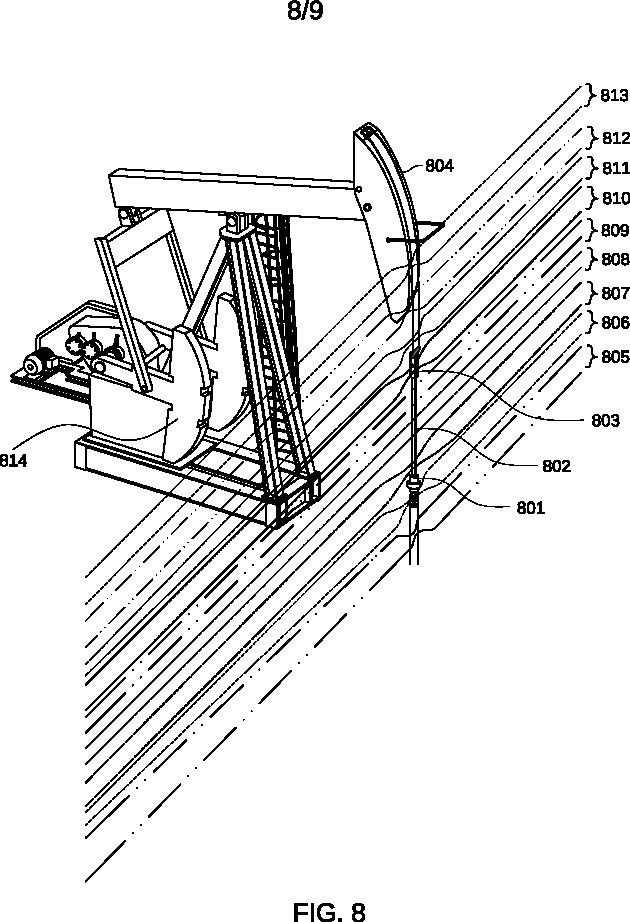
"The particular chain of sensing events" just naturally falls out of this. You can then go to my disclosure text to see exactly where this is disclosed, just not "exactly what they said, exactly how they said it." It's fundamentally the same thing, in the same order.
But the examiner should have known § 102 also includes "inherently", right? You'd hope so, but that didn't come through in the correspondence. The examiner didn't unwind the previous two § 102 admissions (first and final office actions) that I taught the very thing that was then mysteriously found as allowable. And in the same breath, conflated the § 103 objection by discussing another prior art document.
The Notice of Allowance is a mess — you should read it. Try to tell me this misleading argument about me not "explicitly" stating it had no bearing on this conclusion. Or that the examiner just lumped the § 102 and § 103 objections together.
This incredibly misleading statement has no bearing on validity, and on its own is not grounds for a PGR.
There is no penalty for this misleading statement. I am the one this harms and I had no way to prevent this.
Where this plays out in full: Dispatch No. 13 — You Still Don't Believe Me About the Direction Change Thing? — the Figure 8 that shows the “missing” element was inherently there the whole time.
Plus the § 102 and § 103 posts:
- Dispatch No. 22 — § 102 — Nothing New Here — the full anticipation case, element by element, with claim 13 as the cleanest single-reference target.
- Dispatch No. 23 — § 103 — Obvious to Anyone in the Field — the full obviousness case, and the ground I actually lead with in the petition.
The typos
Typos happen. The USPTO is actually really forgiving in this regard. Maybe too forgiving. It's hard to attach malice to a typo. Or I should say it's hard to prove. I don't know if these were cleverly crafted or truly innocent. The end result is the same for me. Here's an analogy: if you accidentally run someone over, you're still in trouble. If you accidentally run someone over and you flee the scene, you're in more trouble. If you run them over on purpose, then you're in big trouble. I can't be sure which it is, and I can't prove any of them.
- Dispatch No. 9 — The Overly Broad Claim Slipped Through — the typo-riddled office actions, the unmarked amendments, and the overly broad claim nobody caught.
- Dispatch No. 16 — Claim 13 — Again — the misquoted claim text nobody on the other side caught.
Examiner inexperience?

I'm not absolutely certain on this, but I did some investigation and across all of the examiner's case histories, this was the only third-party preissuance submission. If you reach a point where you have no experience, you consult the rules and realize your only responsibility is to copy the document numbers. Maybe the examiner followed the letter of the law too closely? Unlikely given the quality of the responses, so I'm inclined to think it was more incompetence. The lack of guidance on how to handle third-party preissuance submissions is a fundamental problem in the way the system was conceived.
If someone goes to the trouble of calling attention to prior art, the examiner should give it more attention, not less.
- Dispatch No. 1 — I tried to prevent this mess — the preissuance submission that put the prior art in front of the examiner.
- Dispatch No. 6 — The Third-Party Preissuance Submission — what that submission actually requires: a document number in the record, and nothing more.
In fairness to the good examiners

I'm hard on this one examiner, but plenty of examiners do careful, honest work under real-time pressure. I would like to offer my apologies to all the good examiners who thoroughly review and examine applications. The ones that aren't a rubber stamp for approval. Even the difficult examiners. Actually… especially the difficult examiners. A difficult examination is at least a thorough examination. Why are they not all thorough examinations?
- Dispatch No. 14 — My Apology to Good Examiners — the caveat that keeps this honest.
The PGR Grounds
§ 102 — Is it new?
No. That's the simple TL;DR; for this one.
I disclosed it all. Like I discussed above, it's inherently disclosed. It's almost entirely in my Figure 8. Pretty clearly at that. The rest is in my disclosure if you actually read it.
- Dispatch No. 22 — § 102 — Nothing New Here — the full anticipation case, element by element, with claim 13 as the cleanest single-reference target.
§ 103 — Is it obvious?
Yes — and that's the simple TL;DR; for this one. Take known sensors, point them at a known problem, and you land right on the claim. It's obvious because this was pointed out in at least two documents (mine and the other one) and all the supposed missing pieces are common POSITA knowledge or contained in other well-known and obvious publications.
- Dispatch No. 4 — The first time this idea was good enough to copy — the earlier, pre-patent episode that first showed this idea was worth copying.
- Dispatch No. 15 — Strapping Cell Phones to Oil Wells — why bolting off-the-shelf sensors onto a known problem is the definition of obvious.
- Dispatch No. 23 — § 103 — Obvious to Anyone in the Field — the full obviousness case, and the ground I actually lead with in the petition.
§ 112 — Did they actually teach it?
No. That's the simple TL;DR; for this one. Woefully incomplete disclosure. I don't think they could have said any less about how it actually works.
- Dispatch No. 18 — Indefinite and Unenabled — the claim terms that were never defined or taught.
- Dispatch No. 19 — Bounding to a single stroke — the construction fight at the heart of the § 112 case.
- Dispatch No. 20 — New material, not in the disclosure — claim language with no support in the original spec.
- Dispatch No. 24 — § 112 — They Never Said How — the full written-description, enablement, and definiteness case.
Other things
After the damage — no fix, no penalty
The patent issued. Nobody got fired, nobody paid a fine, and there's no cheap way to undo it. Two things stand out.
Suspicious timing
The allowance landed five days before an $8B acquisition closed. I'm not claiming anything improper — just that the dates make you look twice.
- Dispatch No. 11 — Suspicious Allowance Timing — the timeline, and why those dates raise an eyebrow.
No safety valve — just a $60,000 door
Once it issues, there's no in-process correction. The only door left is a roughly $60,000 PGR — and the micro-entity discount that's supposed to help the little guy is carved right out of that fee.
- Dispatch No. 3 — A Man Who Is His Own Lawyer Has a Fool for a Client — pro se, micro-entity, and the fee trap that prices inventors out.
Why you should believe me
Any one of these, on its own, you could wave off. A typo. A sloppy office action. An aggressive argument. But line them all up on the board — the copying, the one-sided record, the dropped “inherently,” the typos, the timing — and the pattern is the point. That's the whole case, on one board.
Related dispatches
- Dispatch No. 25 — TL;DR; §§ 101, 102, 103, and 112 — the longer recap of the statutory grounds.
- Dispatch No. 26 — TL;DR; All the system failures — the longer recap of the procedural and institutional failures.
- Dispatch No. 28 — Let's Fix It — the closing dispatch, trading complaint for concrete fixes.
Discussion