
Dispatch No. 23 ← Previous ↰ All Next →
§ 103 — Obvious to Anyone in the Field


§ 103 — the obviousness bar: even when no single reference has everything, a claim falls if the gaps would have been obvious to a person of ordinary skill. These gaps are trivial. In a functional system, that’s how it’s supposed to work. But this isn’t a story about a functional system.
Background — part of my pro se Post Grant Review of U.S. Patent 12,460,537, which I believe copies rotation-sensing I disclosed first. This one is the § 103 ground: even if you don't buy straight anticipation, the gaps over the prior art are trivial and obvious. New here? Start at Dispatch No. 1.
§ 103 — Obvious to anyone in the field
§ 102 asked the narrow question: is every element already sitting in one document? I say yes — twice over (2 independent documents). But suppose you don't buy it. Suppose you side with the applicant that some element isn't worded quite their way, or lives one paragraph over from where they'd like it. Fine. That gap is exactly what § 103 was written to close. § 103 says a claim is no good if the differences over the prior art would have been obvious to a person of ordinary skill in the art — not a genius, just an ordinary practitioner. And the "differences" here are trivial. The framework here has been settled since Graham v. John Deere Co., 383 U.S. 1 (1966): you weigh the scope and content of the prior art, the differences between it and the claim, and the level of ordinary skill in the art, and then ask whether those differences would have been obvious. Keep that lens on as we go — and keep this in mind while you do: neither the examiner nor the applicant's attorney is required to be a POSITA. The standard just assumes they are. By the end of this, you'll see exactly what that assumption costs.
Bounding to a stroke was already obvious
Let's take a closer look at what a POSITA already knew. The '537 patent's headline novelty is a sensing chain that limits rotation detection to the bounds of a stroke — first, second, and third change of direction. That's portrayed as novel. But a POSITA doesn't arrive at "bound the sensing to a stroke" through any flash of insight — the stroke is the fundamental unit of analysis in this field. § 103 doesn't require a smoking-gun reference that says those exact words; it requires that a POSITA would have gotten there without inventive effort. Hurst — the first significant patent in this space — makes that plain.
[Hurst background section]
With each stroke of the pumping unit, the rotator may rotate the rods a fraction of one revolution
That's Hurst's background section — not a novel teaching, but an established description of how the system works. A POSITA reading that background knows rotation sensing happens per stroke by definition — the stroke is already the natural analysis window. And Hurst didn't stop at acknowledging it in passing — it built a claim on it:
[Hurst claim 1]
wherein the expected value is based on strokes of a pumping unit in the reciprocating rod lift system and on a rotational angle associated with each of the strokes
So the field already understood that rotation is a per-stroke phenomenon, and had already staked a claim on a system that accounts for it. A POSITA starting there and adding any rotation sensor arrives at "bound the sensing to a stroke" without inventive effort — it's the only natural fit. That's textbook § 103: what the field already understands isn't something you can patent.
The § 102 angle — that my own published application explicitly shows how to do this particular sensing with a magnetometer — is covered in Dispatch No. 22. To be clear, Hurst isn't a ground I'm raising — the examiner already used it during prosecution (it was the basis of the § 103 rejections on the tubing-rotator claims), so it sits here as state-of-the-art context, not a fresh combination to lean on. Building a new § 103 on Hurst would just invite a § 325(d) "we already considered that" denial. The petition's § 103 runs on Phillips and Fyfe; Hurst just shows the field already treated the stroke as the unit of analysis.
More obviousness
Hurst covers the background knowledge case. For the combination case, Fyfe — two paragraphs of the same reference, on the same device — is cleaner still. The setup is almost ironic: the strongest § 103 argument comes from the very move you'd use to dodge § 102. First, the magnetometer that marks every stroke boundary — the direction changes themselves:
[Fyfe]
[0035] To improve position determined by double integration from accelerometer readings taken within the polished-rod dynamometer 261, we identify 1101 (FIG. 9) the same instant, or tick, of each stroke, such as with an external magnet and magnetometer, or recognize another repeating signal from the pumpjack combined with known pumpjack kinematics. We use this tick knowing the polished-rod velocity should be the same at the beginning and end of each identified stroke, and the polished-rod position should be the same at the beginning and end of the identified strokes. We also know, based upon the pumpjack design, the “range” of position from the maximum position minus the minimum position over the duration of the stroke.[0037] … A robust search 1106 for maxima and/or minima in this velocity is then be [sic] used to detect strokes, a reference tick may be at a maximum or a minimum of velocity. This approach is preferable to working with the accelerometer signal alone because integration reduces noise. … In an alternative embodiment, both minima and maxima are identified within each stroke so that the stroke is separated into two pieces, such as time from minima to maxima and from maxima to minima. Scaling is then applied to each half of the stroke independently.
The gap here is that they use a distinct "magnet." But guess what? The wellhead and other components act as a magnet — in some cases in the traditional sense (they can be literally magnetized), and in all cases they alter the magnetic field. See my Figure 8.
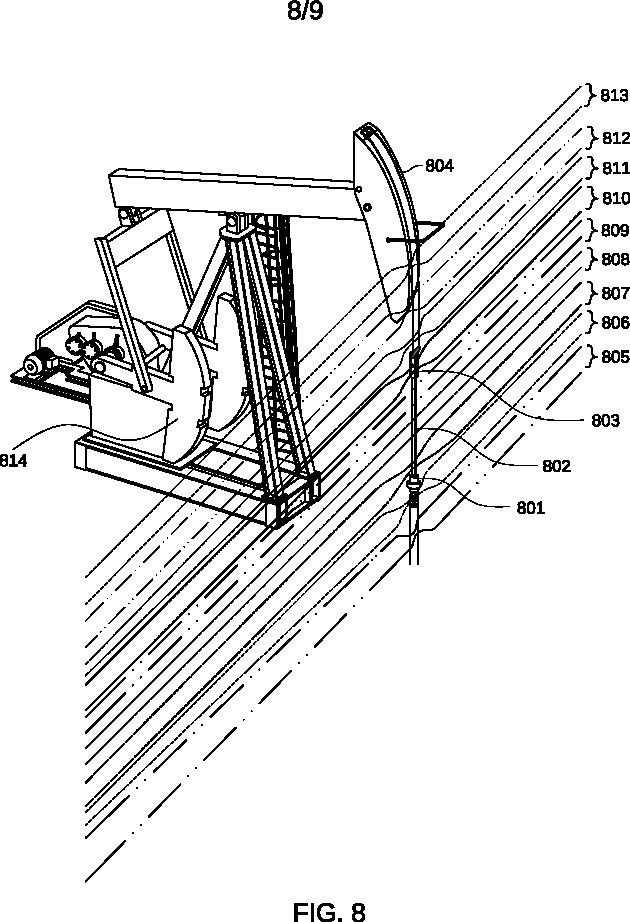
And then, in an alternative embodiment, the rotation sensing during that stroke:
[Fyfe]
[0071] In an alternative embodiment, the polished-rod dynamometer 261 includes calibrated rotational accelerometers and rate-gyro sensors to sense rotational accelerations of the polished rod 224 … during each stroke of the polished rod…
A stickler will say: for anticipation you can't bolt one embodiment onto another. The rate-gyro lives in "an alternative embodiment," so — the argument goes — it can't count toward a single-reference § 102. OK. The second you say that, you've walked straight into § 103. Combining two embodiments of the same reference, on the same device (it's the same dynamometer 261), aimed at the same problem, is about as textbook an obviousness combination as exists. Same author, same machine, same disclosure, telling you to do the thing. There's no leap, and there's no surprise.
That's the whole idea of obviousness. You don't get a patent for snapping known pieces together the way they were already meant to snap, with a result anyone could predict. Same field, same purpose, predictable outcome — that's the definition of obvious, not the definition of an invention. And that's not just my gut talking: it's the KSR test (KSR Int'l Co. v. Teleflex Inc., 550 U.S. 398 (2007)) — known elements, combined by known methods, to yield a predictable result, with a reasonable expectation that it works. Nobody "taught away" from it. Nothing unexpected happened. You read [0035], you read [0071], and a competent person in the field combines them before lunch. And the reason to combine isn't hindsight reconstruction from my claim — it's written into Fyfe itself: the same device (dynamometer 261), the same goal. When the reference itself points you to put the pieces together, you're reading its teaching, not working backward from the answer — which is the standard answer to a "you're using hindsight" charge, and it holds here.
Reason to combine
It's not enough for a § 103 to just stitch together a couple random unconnected disclosures. There has to be a reason to combine them — and here it's a fundamental task in the art: everything we do in the analysis of this type of system splits the continuous motion into discrete strokes. That alone makes the combination obvious. If you don't believe my Figure 8 discloses how to split the stroke based on the profiled magnetic field readings, you can pull that from other prior art within reason. There's a wealth of well-known ways to split the stroke: inclinometers, accelerometers, string potentiometers, magnetic switches placed all over the mechanical linkage components. Books, automation controller manuals, even tradeshow giveaway mousepads.
Fyfe and Mine
And if you still want every reference to stand on its own two feet — then combine the two references. Fyfe and my own published application sit in the same narrow corner of the world: downhole pump-rod instrumentation, the same problem, the same family of inertial and magnetic sensors, specifically targeted at rotation sensing. The motivation to put them together isn't some clever litigation theory — it's right there in the references: they're targeted at the same problem. That articulated reason, with its predictable result, is exactly the "rational underpinning" the law asks for — not hindsight, and not "because the claim says so." Garden-variety § 103.
Go back and read Dispatch No. 4. That's not a legal basis for combining under § 103, but it should give you some context about how closely related these documents are. Post 2018, combining these references under § 103 is fair game.
And the "gap" is nothing anyway
After all of that, look at what the supposed gap even is. The claim's headline novelty is bounding the sensing to a single stroke — first change of direction, second, third. I've beaten this to death in Dispatch No. 19: a stroke is its direction changes. A pumpjack is a four-bar linkage — a mechanism older than nearly every machine you can name — and it goes up, stops, comes down, stops. Those stops are the direction changes. Disclosing "sense it over a stroke" and then treating "first, second, third direction change" as a separate inventive leap is like patenting a staircase and then re-patenting "a thing that has steps to climb and then descend."
You don't need a person of ordinary skill for that. A high-school physics student gets there — the PBASITA (Person of Below Average Skill In The Art) I coined in the § 102 post gets there. This is the "we painted it orange" move all over again: take something fully disclosed, re-describe one obvious corner of it in fresh words, and call the re-description an invention. § 103 exists precisely to stop that. These are exactly the kind of differences a person in the field fills in without thinking — which is the legal way of saying there's nothing here.
Claim 13 got a § 103!
That's the law. Here's what actually happened in prosecution. This illustrates the amendment chain that led from a § 102 to a § 103 — and how the examiner still failed to stop it.
Remember, claim 13 got a § 102 in the First OA. Fully anticipated.
Here's the game plan: The examiner said something about a vibration sensor not being anticipated by me. OK, try adding that vibration sensor to the claim to weasel out of the § 102. And here's where the examiner sort of did the right thing (assuming the accelerometer isn't the very definition of a vibration sensor… I still have a problem with that).
Straight from the Final OA:
[Final OA, page 14]
Therefore, it would have been obvious to a person of ordinary skill in the art prior to the effective filing date of the claimed invention to have modified Phillips to incorporate the teachings of Puwanto by including: a vibration measuring device in order to give early warning of component failure.

OK, let's assume I didn't explicitly say a vibration sensor in three axes (I did, but let's run with this to show the § 103). And let's assume early warning of rotation-component failure wasn't the whole point of my invention (it was). This should have been a straightforward § 102.
But in the § 103 sense (for illustrative purposes), this other reference is obvious to combine with mine to add the vibration measuring device (that definitely isn't an accelerometer, because that's not a "vibration measuring device"). That's an obvious combination and perfectly suited for a § 103 (but again, I disclosed all of this, so it really should have been a § 102… but since it's obviously combinable § 103 works).
Recap: claim 13 drew a § 102 in the First OA, then a § 103 in the Final — both anticipated and obvious. Pretty comprehensive. What changed going into the Final was the added vibration sensor, which is what pulled in Puwanto for the § 103.
Only afterward, at the RCE, did they yank the vibration sensor back out and swap in brand-new material — the stuff about comparing to a previous stroke that wasn't disclosed — and that's what finally got it allowed. New material bolted on at the end doesn't unwind a § 102 and a § 103, unless you have a lazy examiner, I suppose.
Puwanto isn't even a good reference
The Puwanto citation that both my examiner and their examiner leaned on was a stretch. Drilling (making the well) and production (getting the oil out) are very different disciplines. There are much closer and equally relevant citations. Here's a much better one. That's a comment on the quality of the examiner's combination, not a concession — the § 103 on the core stroke-bounding claim doesn't need Puwanto at all. Puwanto only entered the picture because of the vibration sensor addition, which was always the sideshow. Since it was pulled in the RCE, I guess that bypasses the § 103, but that doesn't fix the earlier § 102.
You can follow the claim adds and deletes here:
Claim 13 had the vibration sensor added. That didn't work (see the § 103), so they removed it and added the new material. I can't make this up. It's right there in the amendment chain in the documents above. The vibration sensor was always a sideshow — the headline novelty, bounding the sensing to a single stroke, had its own prior art problem, as the foregoing analysis shows. And the examiner who should have caught it never did.
What actually bugs me about the § 103
Here's the part that gets me: the examiner did raise a § 103 in the Final Rejection. Just not on the claim that mattered. Claim 13 — the overly broad one that actually slipped through — never got the § 103 treatment it had coming. The obviousness analysis landed on claims that were going to be fine anyway, while the one claim that needed a hard look skated past untouched.
That's the same pattern from Dispatch No. 16: claim 1 gets the scrutiny, the later independent claims coast, and an applicant who knows that can park their broadest claim down the list and bank on nobody running it through the wringer. Here, nobody did.
It goes further than just § 103. That same Final OA's § 102 analysis has the same problem: claim 13 appears in the rejection header — "Claims 1-7 and 13-15 are rejected under 35 U.S.C. 102(a)(1) as being anticipated by Phillips" — but the body of that rejection analyzes claims 19-20, which are unrelated. The examiner listed claim 13 and then wrote the analysis for different claims. Whether claim 13 got a substantive § 102 look in the Final, or just got swept into a header nobody backed up with real analysis, is genuinely unclear. No real § 103 on claim 13, and — in this Final OA — possibly no real § 102 behind that header either (the First OA's § 102 was genuine; this Final redo wasn't). By the time it mattered, claim 13 was sailing through on fumes.
Pick your lane
So pick a lane. If every element is there as I read it — and it is — the claim is anticipated under § 102. If you'd rather quibble that an element is one embodiment over or one synonym off, then closing that gap is obvious under § 103. The claim doesn't make it through either door. Unless you have a lazy examiner.
§ 103 is the sturdiest of the bunch: it holds whether or not the Board adopts my stroke construction, where the § 102 anticipation needs that construction to land. My favorite objection is § 112 — enablement, where you claim a result without teaching how to reach it — and that's the § 112 case I mentioned in the previous post. I'll come back to it in the next post.
§ 103 is a very good reason to put this garbage patent out of its misery.
Related dispatches
- Dispatch No. 14 — My Apology to Good Examiners — the systemic context behind examination failures, and why the criticism isn't aimed at examiners who do the job right.
- Dispatch No. 19 — Bounding to a single stroke — the construction fight at the heart of the § 112 case.
- Dispatch No. 20 — New material, not in the disclosure — the “previous stroke” written-description / new-matter problem.
- Dispatch No. 21 — § 101 — What Even Counts as an Invention — two dispatches back; the front-door eligibility discussion that opens this run through the statutes.
- Dispatch No. 22 — § 102 — Nothing New Here — the previous dispatch; anticipation, where this obviousness argument picks up the "alternative embodiment" thread.
- Dispatch No. 24 — § 112 — They Never Said How — the next dispatch.
- Dispatch No. 25 — TL;DR; §§ 101, 102, 103, and 112 — the one-page recap tying it all together.
Discussion