
Dispatch No. 26 ← Previous ↰ All Next →
TL;DR; All the system failures

Every place the system failed me: the copying, the unread prior art, the sloppy examination, and most importantly, the misleading statements. These are all the ways the system can fail, but are still not reason enough to revoke an issued patent. It's a lot.
Background — part of my pro se Post Grant Review of U.S. Patent 12,460,537, which I believe copies rotation-sensing I disclosed first. This one gathers every place the system failed me (that I know of). The copying, unread prior art, sloppy examination, misleading statements — none of which, by itself, is grounds to cancel a patent. New here? Start at Dispatch No. 1.
Table of Contents
This one got long too. Here are shortcuts for this page:
- Not grounds for a PGR
- No way to respond, in real time
- Sloppy examination & proofreading
- Misleading the examiner
- Other things
- Related dispatches
Not grounds for a PGR
Typos, misquoted claims, misleading arguments, so many obvious and significant failures. It's all in the paper trail. But all this means absolutely nothing.
A garbage examination can result in perfectly valid claims that would hold up to a challenge. Likewise, a thoroughly rigorous examination could result in claims that would fall apart under a significant challenge. I honestly don't know what the point of examination is aside from a light filter.
Surprisingly, none of the errors or failures below are grounds for a PGR. I have plenty of §§ 102, 103, & 112 grounds for the actual PGR. But it is important to see how all of those completely failed in this horribly mishandled examination.
This post is about the ways the system can screw up and how that has absolutely no bearing on validity. All the things that don't move the needle on my bottom line, but are worth talking about. They indicate how broken the system really is.
Remember that cartoon about no downside from the home page? This is it. No one got in trouble. None of this is "illegal" — or if it is, I'm not qualified to comment on that part.
The system has no shame

No one got fired. No one paid a fine (well, except for me, the innocent party). As far as I can tell, nobody even got a stern talking to, or even a "shame on you." How do you keep a system honest when you reward plagiarism and punish the folks (like me) who try and call it out? I don't want to get anyone in trouble, but seriously, the system let this happen. That is how the flawed system perpetuates itself.
The result: you can be so emboldened as to copy, almost word-for-word, the exact document you are trying to rip off.* Because it works. Because no one says this is not OK. No one says "shame!"
* To be clear, “copy” and “rip off” are my plain-English characterization of what the public, side-by-side record looks like to me — my opinion, not a legal finding or an allegation of inequitable conduct. And copying alone, as I explain throughout, isn't itself a ground for a PGR. ↩
Why discuss this here?

This is pretty much the only place I can publicly air these grievances. This is a story about just how many things can go wrong. Some by accident, some with more questionable intent. It's boring and nuanced. It requires a lot of thought to see how one misleading statement can lead to distraction, which caused some other misinterpretation.
Maybe someone in Congress will do something about this.
It's a lot
When I started down this investigation, I had the copying. That much was obvious. Unfortunately, the USPTO doesn't care about that. OK, Fine. But that was just the tip of the iceberg. Sloppy examination and deceptive, one-sided arguments, and more led to this situation.
And the typos. So many typos. Some seemingly innocent. The thing about a typo is it's a mistake, and the USPTO is pretty forgiving of mistakes (probably too forgiving in some cases). There are some typos here that raise some deeper questions.
No way to respond, in real time

I understand the burden on examination and examiners. If anyone could participate in the process, it would be an even bigger mess. But the flip side is I could have helped avoid these issues. I tried to in my third-party submission, but I couldn't force the examiner to read, understand, or apply that prior art. I was silenced — but the applicant could shift positions and mislead, and I could only watch. I had useful insight, but could not contribute. I saw the examination going off the rails due to misrepresented arguments, but could not help correct the record. Full version in Dispatch No. 10.
Sloppy examination & proofreading
Typos in the office actions, an overly broad claim that slipped through, a misquoted Claim 13 nobody caught. Full version in Dispatch No. 9 and Dispatch No. 16.
Patent quality is atrocious. AI is really good at finding these sorts of technical errors. If anyone at the USPTO wants to know more, I'd be happy to explain it. I found a trove of other technical errors like this in other examinations. I can show you how easy this is. The USPTO really should employ this to improve examination quality.
The tools are available. It's practically like spellcheck at this point.
The examiner never saw a third-party submission
Remember, I made a third-party preissuance submission — the one tool the public has. That was supposed to bring the prior art to the examiner. Nothing in the statute or MPEP, from my reading, requires this to be handled in a substantive way. The only requirement is to enter the document number into the record.
I did a quick search on this examiner's docket history and it seems mine was the only third-party preissuance submission.
This examiner never encountered another third-party preissuance submission.
Maybe the literal letter of the statute was followed. Just copy the document numbers. After all, nothing requires the examiner to actually read the prior art. Still, whether I submitted a carefully curated map of prior art or not should have no bearing. The prior art was already there and the examiner utterly failed to apply it properly. The fact that I had laid out the prior art in great detail and the examination was still so sloppy and haphazard is what is concerning. When I wonder whether something more devious was at play, this is why. If you knew someone was watching and you knew the prior art was so voluminous, wouldn't you try to do your job better, not worse?
Full version in Dispatch No. 1 and Dispatch No. 6.
"Considered," not read
A document number in the file means "considered." Not understood. Not applied. It doesn't even mean it was "read." The dispositive prior art was served up on a platter for the examiner and never substantively engaged. "Ignored" is the term I believe fits this, but "considered" could mean that too. Full version in Dispatch No. 6 and Dispatch No. 8.
Zero § 112 objections
This one is clear. The examiner raised no § 112 objections. Zero! That's a fact. You can check the record. Whether a § 112 objection was warranted or not is up for debate. You can see my deeper discussion in Dispatch No. 24 and Dispatch No. 25. The really short version is in their figures: one generic background drawing, one generic text-only block diagram, and one 3-box linear text-only flow chart (non-repeating flow). You don't need lots of figures, or even good figures (you can see my application for some pretty crappy drawings). But this screams lack of enablement.
Here are all the figures presented in this novel "invention."


You could have a thoroughly enabled and § 112 free application with just 3 figures. But look at the ones above and tell me with a straight face this doesn't scream § 112.
At some gut level, when presented with a patent, you skip to the drawings to see what the invention is. Can you even tell from these drawings? The text disclosure is as thin as the drawings. Again, not § 112 grounds, but it's surprising the examiner didn't even question this.
The vibration sensor

I can't blame this one on the applicant. The examiner just failed to understand this most basic concept. I had a figure. My Figure 3, for a generic 3-axis sensor. I then talk about this figure in the context of the three 3-axis sensors that I use to determine various vibrations of the system. I don't explicitly say "vibration" but that's clearly what I mean… if you apply the "inherently" standard. Really, any reasonable reading of this would get there.
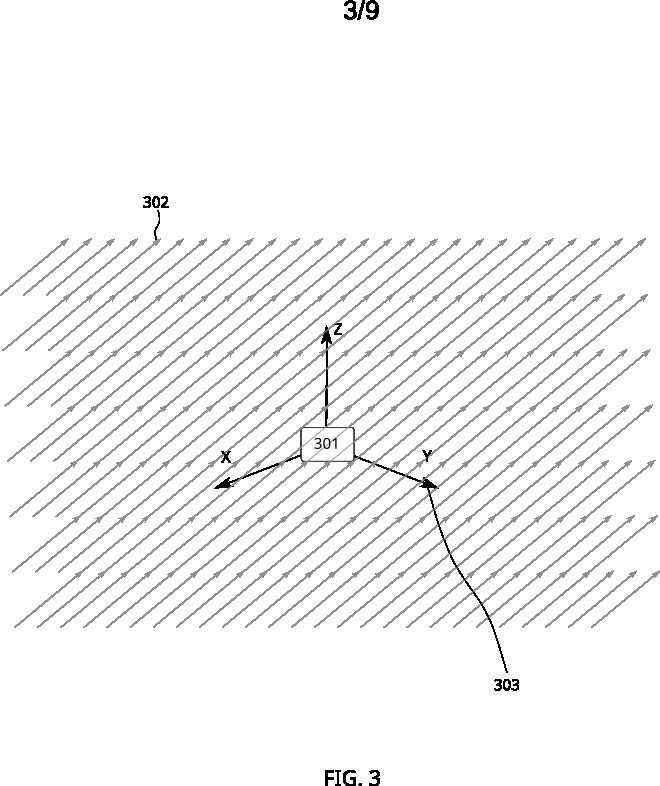
- An accelerometer is naturally a vibration sensor. I don't know how to be more clear about that.
- A gyroscope is a vibration sensor too. I talk about the oscillation (which is a synonym for vibration) that the sensor sees as applied loads and torque changes.
- I am even using the magnetometer as a vibration sensor to capture the low-frequency vibrations of the pumping system. In other words, the cyclic up/down motion that results in this poorly enabled (or not at all enabled) "sinusoid that can be monitored". Remember, I disclosed that through my Figure 8 and supporting disclosure. That's a novel use for a magnetometer.
- The barometric pressure sensor — explicitly not a 3-axis sensor (the accelerometer, gyro, and magnetometer above are each 3-axis sensors), but I also show that it can determine/measure the low-frequency vibrations of the pumping motion. Also a novel use for that sensor. Have you ever heard of a barometric pressure sensor used to detect vibratory motion? Yeah, that was me. (Maybe someone else too, but if so, in a different field.)
Claim 13 got a § 102 and a § 103?
This one is mildly confusing because of yet another typo. Check out page 4 in the Final OA.
[Final OA page 4]
Claims 1-7 and 13-15 are rejected under 35 U.S.C. 102(a)(1) as being anticipated by Phillips (US20190203579A1, 2019-07-04).
And
[Final OA page 12]
Claim 12-15 are rejected under 35 U.S.C. 103 as being unpatentable over Phillips, in view of Puwanto et al. (US 20200362686A1) herein referred to as Puwanto.
The § 102 above is probably(?) a typo, but do we know for sure?
Either way, claim 13 for sure got a § 102 in the First OA. How claim 13 still slid through so easily with both a § 102 and a § 103 is a mystery.
Claim missing allowance restrictions
This one is maddening, and should be higher on this list (I covered it previously here and here). Claim 13 simply was not proofread and so it was carelessly allowed without the examiner's stated limitations.
Analogy: Are you supposed to tell the bank they made a million-dollar mistake? You can't play dumb on this one. The allowance terms were clear. That's what gives the biggest grounds for challenging the validity, but there was no penalty for getting it wrong. They should have fessed up, but once a patent issues, it's hard to fix that. Their downside is practically non-existent, while my downside is substantial. This whole blog is proof. There's no incentive to be honest because there is no penalty for getting a broader claim than you are entitled to (and I don't think they are entitled to any of these claims, but most of all not claim 13).
The examiner should have caught this (it's basic proofreading), but the applicant should have known they got something they weren't technically entitled to. Call this a failure of the whole "honor" system.
Full version in Dispatch No. 9 and Dispatch No. 16.
Misleading the examiner
Were these innocent mistakes, or something worse? You be the judge.
Misleading standards
This one spans multiple arguments. Basically, they created an impression that § 102 was more narrow than it really is. The examiner should have known better, but then again, the examiner should have done a lot better.
In fairness, the applicant initially quoted the § 102 standard of Verdegaal Brothers v. Union Oil Co. of California, 2 USPQ2d 1051, 1053 (Fed. Cir. 1987) correctly.
Recapping: it basically says a single prior art document requires that "each and every element as set forth in the claim is found, either expressly or inherently described, in a single prior art reference" — that's Verdegaal, which they cite once accurately.
That was in the first response, but not in the RCE. This is important because inherently is an operative word that they conveniently omitted in the RCE remarks.
Why is this misleading? I sure think so. In the RCE remarks, that standard quietly became explicitly, conveniently dropping the inherently which is a huge shift.
[Applicant RCE Remarks]
there is no disclosure in Phillips of the particular chain of sensing events, including explicitly reciting the conditions for the starting and stopping events of the rotational sensing, as detailed in amended claim 1
The standard of "either expressly or inherently" is expansive — it doesn't even require a POSITA's reading. I'm fine with that standard here. But, by subsequently dropping the key inherently term, it effectively shifts the impression of the standard to appear far more restrictive than it actually is. Imagine being an easily fooled examiner. I could be wrong, but this sure seems to explain how this flimsy argument was so "persuasive."
If I didn't say exactly what they say, exactly as they say it, they should get a patent. That sounds fair to you, right? That's how innovation works in the US these days.
Sadly it worked. The examiner bought that argument.
Here's the problem: I do say exactly what they say when applying the reasonable inherently standard. Remember, they literally copied me, so I should say "they say exactly what I say." But they get the benefit of hindsight and wordsmithing. That is precisely why inherently is such a vital concept in § 102 and why I believe dropping it from the subsequent RCE remarks is so deceitful.
Forget whether I even say the things or not. My issue here is how the applicant twisted the § 102 standard in the remarks. I think that's playing dirty pool (either billiards or the other kind). What's the harm in dropping one word? Remember: No downside. No one faced any consequences, except for me.
Also, this is utterly ironic. Here's how I'd caricature the position they argued — my words, not a quote from them: "we lined up with his disclosure where it suited us… but he supposedly didn't anticipate this, because we reworded the part to sound different."
"Effectively a compass"
Sensors can do different things. To "properly" disclose that, you have to talk about all the different things. This means talking about one thing that isn't the other, and vice versa. All the applicant needs to do is find a passage that talks about the opposite and call attention to that one.
Here's an example from the applicant response to the first OA:
[Applicant remarks]
Phillips describes a sensing device that includes a magnetometer and that "[t]he magnetometer is effectively a compass that identifies a radial orientation of the sensor relative to a fixed external location such as true north." Phillips, ¶ [0022] (emphasis added).

Phillips does not appear to describe, however, that the magnetometer is used to "measure axial movement of the at least one component of the downhole pumping system based on variations in a magnet [sic] field detected by the magnetometer" as recited in claim 1.
The first statement is true, but why point it out if not to mislead the examiner? Why call attention to the use of a sensor in the other aspect if not to create a false impression of the disclosure in the examiner's mind?
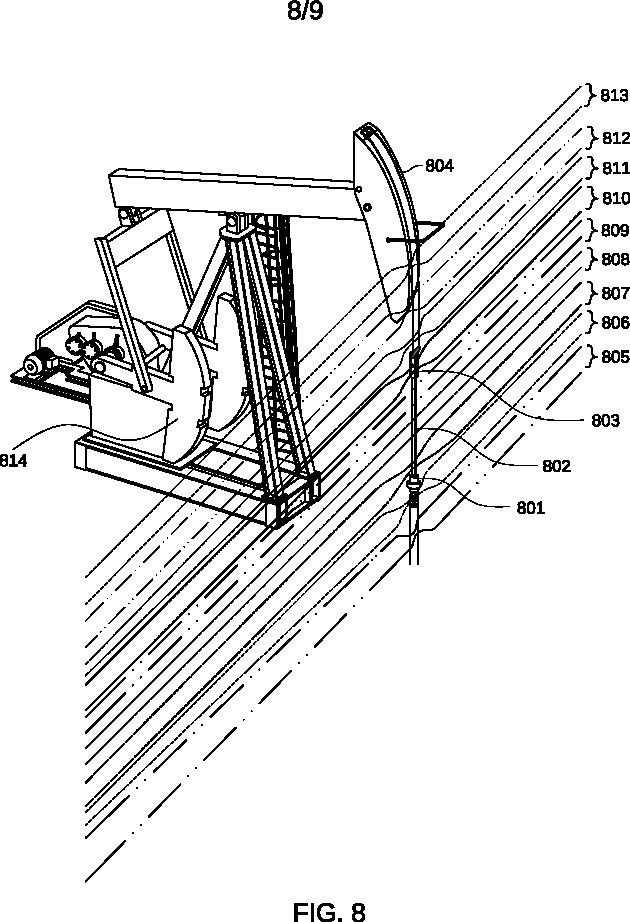
The second statement is just wrong. Claude says this is a "misdirection by half-truth — suppressio veri, suggestio falsi" but I don't speak Latin, so I don't know for sure. I do know what I disclosed and here's my Figure 8 for proof. I illustrate field lines through the stroke. How can I be more clear about "measur[ing] axial movement"…"based on variations in a magnet [sic] field detected by the magnetometer" than this drawing? This is "how" you measure position. See Dispatch No. 24 — § 112.
"seemingly contradictory statements"
The one-sided, closed to the public nature of examination means the applicant can pull the "seemingly contradictory statements" out of context and create confusion in the examination. Here's an example from the applicant response to the first OA:
[Applicant remarks]
While Phillips appears to make some contradictory statements regarding movement of polished rod, at best, Phillips only appears to be capable of detecting whether the rod is moving or not. However, the configurations of Phillips do not appear to be capable of measuring axial movement with the magnetometer.
I drew a detailed picture of exactly this. Figure 8. I've harped on this a lot here. There's a lot packed into that image. Given that the applicant was clearly familiar with my document — the side-by-side record reads to me like copying; see Dispatch No. 4 — when they say this, I find it hard to square with that record.
Broadened claim language
This was in the amended claims presented to the examiner in the RCE.
This is sneaky, so stick with me here… They basically argue they're doing something narrower (fine and reasonable if you believe that), but then they change it right back to be exactly the broader thing that they are on record saying that I say. I can't make this stuff up.
Let's look back at the previous remarks to the first OA (and sorry for the repeated quote, but this is worth it):
[Applicant remarks]
While Phillips appears to make some contradictory statements regarding movement of polished rod, at best, Phillips only appears to be capable of detecting whether the rod is moving or not. However, the configurations of Phillips do not appear to be capable of measuring axial movement with the magnetometer.
They argue the prior art — Phillips, and by extension my disclosure — is only capable of detecting, not measuring. Pretty simple, "measuring" is a narrower term than "detecting." Seems reasonable, doesn't it? (ignore my Figure 8 for this)
OK, let's track this through the claim amendments in chronological order:
[Claim 1 preamble]
…
a processor subsystem to receive data from the axial motion sensor subsystem and the rotation sensor subsystem, the processor subsystem to:

You see what they did here, right? They argued I don't "measure" because that term is narrower than "detecting." It's a BS argument when you simply look at my Figure 8, but they literally just copied me again in the last claim amendment despite saying they do the narrower "measuring." Just slip the broader term back in and hope no one notices… right?
This is insane — and there's no penalty for it. Even if you're on their side and believe that I didn't disclose "measure," how do you justify this? And how was it so easy for the examiner to fall for it?
Another in a long list of what I read as shady actions by the applicant and, in my opinion, an inattentive examiner who was asleep at the switch again.
New material in the claim
Comparing against a previous stroke is not disclosed anywhere in their application.
Let's look at the RCE, page 5:
[Their Arguments/Remarks from the RCE]
Further, while Phillips discussed some comparison of values, Phillips does not disclose using the value detected during a previous stroke to determine if rotation of the at least one component of the downhole pumping system has occurred. [Their emphasis, not mine]

Did they even disclose this?
No! It's not even in their written specification. They say stuff like "during an entire stroke" and "during the stroke" (which I state 20 times in various contexts in my disclosure). But in their disclosure, no "previous," no equivalent term. There's a "baseline," but that refers to vibration, not a discrete stroke. There's no illustrative drawing you can point to. Nothing.
But I made a drawing for this very concept in my application.

But there is a very good argument that I disclose exactly this. See my Figure 6. The system could run continuously, but since it's a battery-powered device, you want to put it to sleep. In addition to Figure 6, I discuss this in my [0089], [00131], [00152] paragraphs.
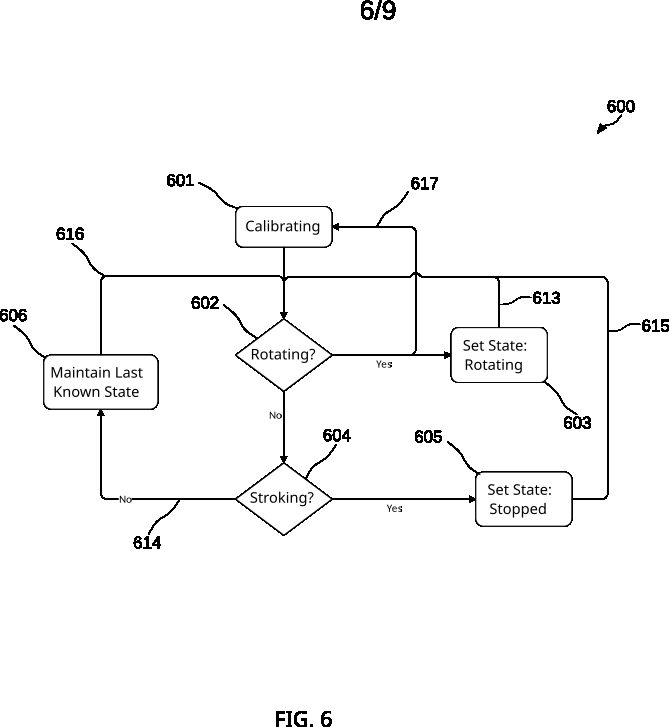
I disclosed it, but they didn't, and it got snuck in the claim without identifying it as new material. This is a two-for-one. A claim date issue, and a clear § 112. Yet another examiner failure coupled with sneaky (in my opinion) amendments. If you know the examiner isn't paying attention, why not try to push the envelope? No downside, remember?
Full version in Dispatch No. 20.
Amendments without proper markup
Minor? I have bigger issues with the vibration sensor as portrayed by the examiner. But on the applicant's side, they deleted the vibration sensor from claim 13 and added it to claim 1 without the appropriate markup. That's an important nuance to the Notice of Allowance showing how little scrutiny was given to this application.
The line in question is:
a vibration sensor subsystem for monitoring vibration of the at least one component of the downhole pumping system in three axes; and
- It's not in the Original claim 1 or 13.
- It appears in the First Amended Claims with no markup in claim 1, but with markup in claim 13.
- Then it was removed (with markup) from claim 13 and left with no markup in claim 1 in the RCE Amended Claims.
I have a couple issues with this. The lack of markup in claim 1 is an obvious problem. Removing it from claim 13, effectively broadening it, especially right when the examiner was supposedly reviewing that very claim, is a different problem. Plus it's absent from the other independent claims which raises the larger question of examination proofreading across all claims. I think I've made a pretty compelling case that the claims were not adequately reviewed against the allowable material. I wonder if they were read at all.
You can follow the claim adds and deletes here:
Mismatched terms in claims vs. arguments
We've already established this examination didn't pay close attention to details. Here's another example:
- The granted claim (Amended Claim 1) says: "after the direction change… has been detected, begin to determine rotation."
- The applicant's RCE remarks say: "rotation sensing only occurs once a direction change is sensed."
Which is it? And if it truly is after, isn't that exactly what I already disclosed by "over the course of a stroke" i.e. looking back, after, and parsing out the stroke like we've done since at least 1967, and likely long before that? If you could do it once a direction change is sensed, that would at least be interesting, but still not enabled in the disclosure. By the way, to do this in a real-time/immediate approach like they describe involves a lot of modeling and predictive algorithms. That's totally unenabled and totally unacknowledged in their disclosure.
Misrepresented claim text
This "typo" is squarely on the applicant.
The text of a claim 13 quotation in the RCE remarks is not the text in the amended claim 13.
This one is hard to spot. Here it is on the first page of the RCE remarks:
In particular, Phillips does not describe the sensor system of amended claim 13 including a processor subsystem to:
Is it just an innocent typo? I don't think so, especially since it made claim 13 appear to have the same limitations as claim 1.†
† That's my opinion about a discrepancy in the public record, not a finding — I can't see intent. I'm not alleging, and the PGR does not allege, inequitable conduct or any breach of the duty of candor. My point is narrower: the claim text quoted in the remarks doesn't match the amended claim, and that mismatch lines up with the examiner's confusion. ↩
Look at page 1 of the RCE remarks. That says claim 13, right? But the text is claim 1. If that is an innocent typo, it certainly explains why the examiner thought they all contained the same text:
[Notice of Allowance]
Claim 13, 16 and 19 include analogous, though not necessarily coextensive, features in conjunction with Claim 1, an [sic] is, therefore, along with its dependencies, for similar rationale as disclosed above, allowed.
This one is a much bigger deal than I'm making it out to be. You can draw a straight line from this "innocent" typo straight to the bamboozled Notice of Allowance. The examiner should have caught this, but it sure seemed like claim 1 and 13 had similar text… if you rely on the applicant remarks too heavily (and don't proofread the amended claims), that is.
Other things
Suspicious timing
The allowance landed five days before an $8B acquisition closed. No evidence of anything improper — just dates that make you wonder. Full version in Dispatch No. 11.
I think something shady happened, the timing is too coincidental given all of the other failures. But I can't prove it, so I'll just leave it at that.
No safety valve — just an expensive PGR

There are zero in-process corrections. The only door left is a roughly $60,000 PGR, after the damage is done. Full version in Dispatch No. 24.
Hopefully someone reading this will propose a fix. Ultimately, only Congress can truly fix this. This is actually a bipartisan issue. There aren't many of those these days. It's also an easy thing to understand. They always ask if you have a patent on Shark Tank. All you need to know is it's important and the system is broken. We're (Congress) going to fix it for folks like you out there with great ideas.
What happens to badly examined patents?
Fixing a badly examined patent is painful and expensive. Even when you catch it early enough for a PGR. The problem is an issued patent has an assumption of validity. As best I can tell, if an examiner just allows a patent without examination, that is as valid as one that has been through the wringer (i.e. careful examination and thoughtful restrictions… which hopefully are proofread).
Here's a hypothetical question. I haven't found the answer, but it comes from those settlement press releases‡ that were in the news recently: What happened to those patents examined with the conflict of interest? If I dig further, I might be able to find the answer, but on the surface, my best guess is nothing. From what I can tell, flawed, incompetent, or even corrupt examination doesn't have a safety valve. Again, this is all my opinion and I'd happily issue a correction, but it doesn't seem there is a penalty for any of this. There is no safety valve and Congress really needs to fix this. Bad patents are a scourge, devaluing true innovation and good patents.
‡ A USPTO employee agreed to pay $500,000 to resolve a conflict of interest; a former employee agreed to pay $122,480 over another. ↩
Bottom line
Any one of these failures is a problem. Stacked together, they're how a published application becomes someone else's patent — and why I'm calling attention to all of this.
Related dispatches
- Dispatch No. 1 — I tried to prevent this mess — the ignored preissuance fee.
- Dispatch No. 2 — Why a PGR? — where the § 112 gaps were first flagged.
- Dispatch No. 4 — The first time this idea was good enough to copy — the earlier time this same idea was good enough to copy.
- Dispatch No. 6 — The Third-Party Preissuance Submission — the submission that was "considered," not read.
- Dispatch No. 8 — Back From the Dead — how the rejected application became a patent.
- Dispatch No. 9 — The Overly Broad Claim Slipped Through — the claim that should never have issued.
- Dispatch No. 10 — Post-Allowance, Preissuance — What could I do? — being silenced during examination.
- Dispatch No. 11 — Suspicious Allowance Timing — the timing around the allowance.
- Dispatch No. 12 — A Private Conversation, Held in Public — the misleading characterizations of the record.
- Dispatch No. 16 — Claim 13 — Again — the misquoted claim nobody caught.
- Dispatch No. 20 — New material, not in the disclosure — the claim limitation that isn't in their own disclosure.
- Dispatch No. 22 — § 102 — Nothing New Here — the anticipation ground behind the "misleading § 102 standard" and "new material" sections here.
- Dispatch No. 24 — § 112 — They Never Said How — the ground only the PGR could reach.
- Dispatch No. 25 — TL;DR; §§ 101, 102, 103, and 112 — the companion recap of the legal grounds.
- Dispatch No. 27 — TL;DR; They were too long, so I didn't read them — the even-shorter recap, for when this one ran long too.
- Dispatch No. 28 — Let's Fix It — the closing dispatch, turning these system failures into concrete fixes.
- Dispatch No. 29 — Independence Day — the closing reflection on this same "the system failed me" record.
Discussion